| EP rapporteur wants EC to publish state aid guidelines soon |
|
State aid guidelines for inland waterways, promised since January 2006 as part of Naiades, the action plan for inland navigation, still have not been published, which delays new investments. Once these guidelines have been set out, innovative inland waterway projects such as the development of cleaner engines will no longer have to remain on the shelf due to time-consuming and uncertain procedures in Brussels. Since extensive guidelines have been published for the rail sector in the meantime, MEP Corien Wortmann, rapporteur for Naiades in the EP, pushes for action. More...
|
Recognition of climate change impacts creates opportunities for navigation |
|
The international navigation association (PIANC) published an expert report on climate change drivers, impacts, responses and mitigation related to the waterborne sector. The PIANC report concludes that recognition of current climate change impacts and future impacts provides an opportunity for the navigation community to shape policies, adaptation strategies and mitigation measures for inland and maritime navigation. Exploring global warming impacts and its potential responses helps to create a continuing dialogue for the consideration of adaptation or mitigation strategies by the navigation community. More...
|
Walloon navigation prize goes to animal food producer |
|
At the Shippers' Day of the Office de Promotion du transport par voie navigable (OPVN), the annual prize has this year been awarded to the Dumoulin company for their continuous efforts to ship an increasing part of their volumes by water. In 2007, 21% more freight was shipped than in 2006 and the Dumoulin group, active in food production, will continue to shift more of its products to contribute to more sustainable mobility. The event took place at Tubize, where the aggregates firm Gralex has set up a sophisticated rail-water transport system, illustrating how the EU co-modal policy works in practice. Aggregates are granular materials used in all our constructions, from motorways to private housing, schools, hospitals and decorative architecture. More...
|
Great potential for agro-products on water |
|
More than a third of Europe’s food and agro products are transported by truck, and for the last twenty years, transport of food and agro products on the road has more than doubled. The Interreg project Agroship helps shippers to use the waterway to overcome troubled supply chains by providing expert advice and support. No congestion, but economic benefits and unexpected innovative solutions. Today, Agroship presents the first successful pilots of potato fries and rice transported by inland barge. More...
|
Ile-de-France news cycle takes the river |
|
Nowadays if you buy a newspaper in Paris, it is very likely the paper was transported by water. 20,000 tonnes of paper reach Paris' newspaper and magazine printers by ship, the waste collected in bales is shipped back by barge to Rouen for recycling. By next year, volumes will develop sixfold to reach 120,000 tonnes with the introduction of a new logistic concept based on 45ft intermodal loading units. A fine example of an innovating solution, a round trip for a new liner service sending newly manufactured paper rolls back to Paris after recycling. More...
|
Innovative waste over water solution rewarded |
|
REP (La Routière de l'Est Parisien), a company operating several transfer and treatment centres for household waste in the Paris region, has been awarded, together with SCAT, river transport company specialised in transport of waste containers, the special Prize for logistic sustainable innovation. In 2007 REP opted to shift its waste containers from the Port of Gennevilliers to Précy-sur-Marne to water transport, thereby removing some 4167 trucks (containing over 75,000 tonnes of waste) off the Ile-de-France's busy road network. Several innovative techniques had been developed to implement the system: reinforcing container resistance and adaptation of the barges. More...
|
New ships are cleaner |
|
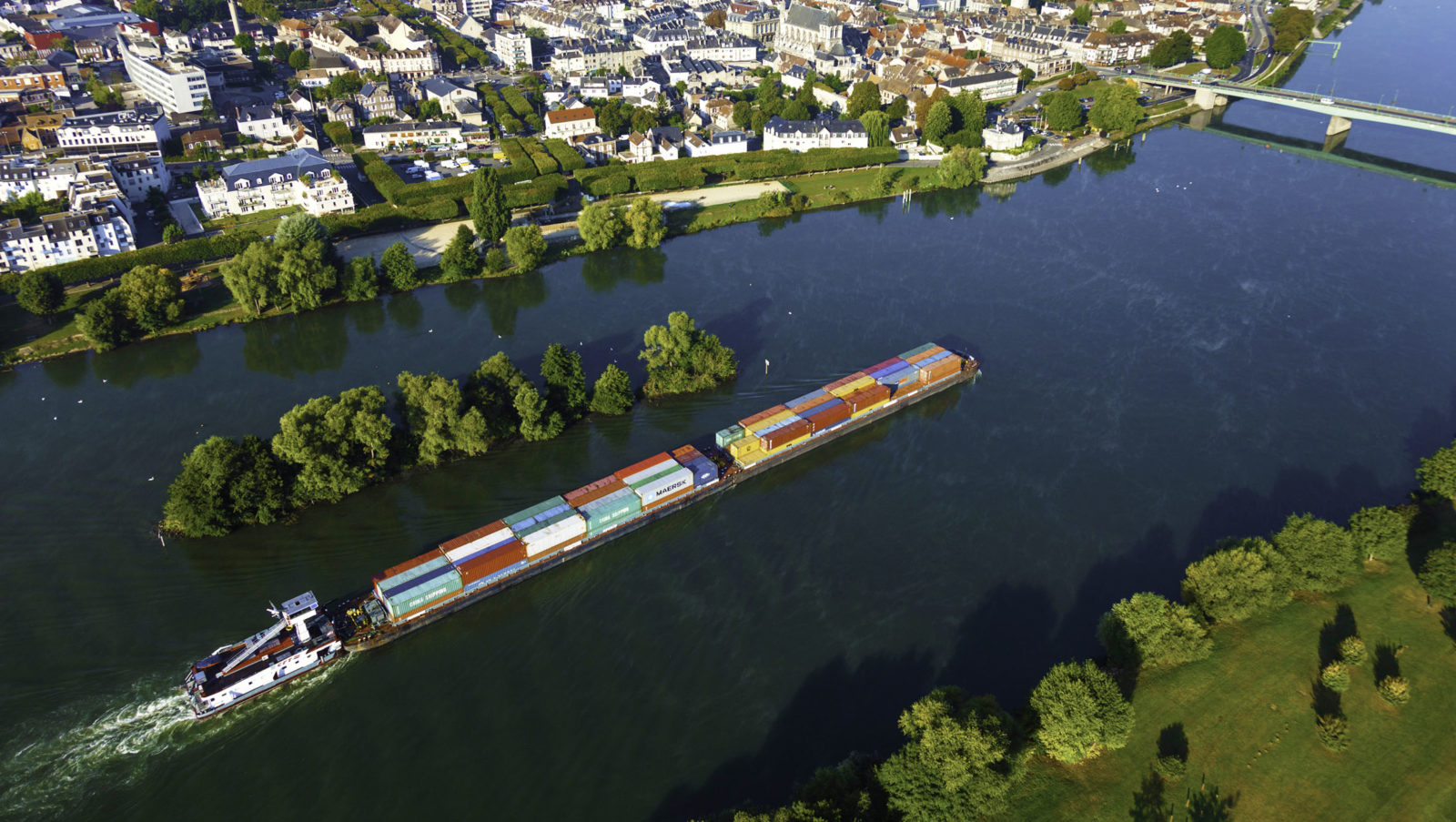
River Shuttle Containers (RSC), CMA CGM’s waterway container shipping subsidiary, specializes in transport. The company introduced 3 new barges which are self-propelled and consume 41% less energy than the pushed barge convoys they replace. They are also 10% faster, providing better overall service to customers. Sustainable development is a commitment and value shared by both RSC and CMA CGM. According to the company, shipping by waterway is an energy saver and the most environmentally friendly way to transport cargo. Each tonne switched from road to waterway cuts CO² emissions by four. River transport is the only mode of shipping that is not congested, and it offers near-perfect reliability of cargo delivery into the heart of metropolitan areas. Moreover, it is also a flexible, efficient alternative to many congested highway routes. More...
|
Netherlands increase stakes in inland ports |
|
The Netherlands created a toolkit for policy makers at regional and local level to sustain the smart development of inland ports to avoid too many key strategic port sites go lost to residential property development and undermine the creation of a truly co-modal network. A reduction of inland waterway transport opportunities results in a “reversed modal shift” adding more trucks to the busy roads and as inland ports create jobs, turnover, profits and welfare, handing in key strategic port sites to residential property development may harm the competitiveness of the economy. The toolkit provides a 10-step approach with instruments to support the analysis and decision making, the government also supports concrete actions of authorities with a ‘quick win’ grant programme of MEUR 62 More...
|
Inland shipping on the small screen |
|
The Dutch office for promotion of inland waterways transport, Bureau Voorlichting Binnenvaart, has published on its website links to segments of the RTL - Transportworld television programme dedicated to inland waterways transport. Subjects include energy saving in inland shipping, deliveries by inland waterways of fuel to seavessels, the importance of inland navigation in the Netherlands, training & education in inland shipping. More...
|
Dutch inland shipping organisation wants ambitious French budget for waterways |
|
Annemarie Jorritsma, who chairs Koninklijke Schuttevaer, called upon the French government to increase financial spending for French waterways. After the major project Seine-Scheldt, another link between Sâone and Moselle should imperatively follow. Annemarie Jorritsma claimed the times of canal share companies are back and called upon seaports, who benefit from better hinterland connections, to play their part. But large-size projects should not develop at the expense of smaller river and canal connections. France's small waterways need a real boost to ensure small ships can offer reliable services. More...
|
Flemish promotion bureau brings good news, but... |
|
2007 was a good year for inland shipping in Flanders, but PBV, the promotion bureau, is convinced it could have been better. Notwithstanding the increase in tonne-kilometre performance, inland shipping may be losing some market share. PBV unveils in its annual report some ongoing long term trends which are reason for concern. The position of inland navigation in Antwerp is under pressure due to terminal congestion and a well-intended rail subsidy scheme has unintended side effects as it has already produced shifts from waterway transport to rail. All opportunities should be seized to allow waterways to play a more active role in diverting the looming mobility crisis. More...
|
Sea and Water develop UK freight vision |
|
Sea and Water unveiled its “vision for UK freight trends towards 2018 and beyond”. This report examines past and present trends in UK freight and makes predictions & recommendations for the future. It outlines the need for a shift towards inter-modality to reduce both CO² emissions and congestion on UK roads. It suggests that if effective strategies were implemented to improve infrastructure and planning policy for freight transport, the amount of road freight could be reduced from 66% to 50%, increasing the amount of both water and rail freight. This could cut 12% of total domestic freight carbon emissions in a decade and help achieve the UK’s goal of reducing CO² emissions by at least 26% by 2020. More...
|
A container terminal as a central hub in Flanders |
|
The TCT terminal in Willebroek near Antwerp, part of ECT, has recently expanded to 1,000sqm, doubling its capacity to 180,000-200,000 TEU. The terminal, currently employing 29 people, will become a central hub in a network of smaller satellite terminals, allowing the shipment of containers in large waves from and to the seaports of Rotterdam, Antwerp and Zeebruges which improves the entire logistic chain. TCT Belgium has the ambition of becoming the ‘extended gate’ of the ECT-terminals in Rotterdam, allowing containers to be shipped directly from the seaport to Willebroek, close to their final destination, for customs clearance. More...
|
Charter for sustainable development signed in France |
|
VNF has signed the Sustainable Development Charter for Public Institutions and Enterprises during the 6th edition of the "Sustainable Development Week" in France. This signature took place during the 3rd edition of the Special Assembly of Companies for Sustainable development which brought together Michele Pappalardo, general commissioner for sustainable development and nearly 400 public decision makers, private companies and associations to discuss innovations for sustainable production and consumption. Signatories of the Charter commit to integrate principles of protection and valorisation of the environment, economic development and social progress in their strategy, management and relationships with their stakeholders, including staff, customers and the general public. More...
|
Seine Scheldt West |
|
A feasibility study combined with a cost-benefit analysis of the Seine-Scheldt West project, ordered by the Flemish government, has been published. It shows the project would obtain an international return of 6.8% if one considers a scenario of substantial increase of traffic of 4 to 5% which seems modest in view of the past results obtained by the Zeebruges port (average growth of 15% from 2004-2007). Seine-Scheldt West aims at a full opening up of the ports of Ostend and Zeebruges to river transport. Only one of three alternatives, evaluated on 10 criteria, would be profitable - the widening of the Schipdonk canal and its linking to the Baudouin canal in the rear area of the Zeebruges port. To appease the concerns of the neighbourhoods on the waterfront, a new study will be launched. More...
|
Berlin & Brandenburg work on better shipping connections |
|
Since 2004 waterborne transshipment volumes have risen by 30% in Berlin and by 17% in Brandenburg, totalling over 8.3 million tonnes of freight. This trend continues in the first months of 2008, and the German transport ministry forecasts a doubling of hinterland traffic by 2025 to 15 million tonnes a year. This will be supported by better water connections to the Rhine and the ports of Hamburg and Sczcecin. Once the planned development of the Mittleren Havel and the Spree below the Charlottenburg lock will be finalised, push-barges 185m in length and 11.45m in width will be able to ship 160 20" containers, up to 3,500 tonnes, to the Westhafen, avoiding some 80 truck movements from Hamburg to Berlin. Noise-free, carbon low and safe. More...
|
Germany compares transport and environmental costs of truck, train & ship |
|
The German research institute PLANCO compared in a recent study the performance and costs of the different land transport modes. Inland shipping continues to lead in the categories fuel efficiency, CO² emissions, noise and safety. With regard to air pollution, inland waterways transport is set to make a big jump forward thanks to cleaner fuel, new engines and abatement technology as well as better regulation. More...
|
Record on the Danube |
|
In 2007 for the first time over 80 million tonnes of goods were transported over the Danube. The Austrian share of this impressive result rose by 11% to 12.1 million tonnes, and by 2015 this number should double to over 25 million tonnes. During the Danube Summit in June a new container line, removing some 7,500 truck movements a year, between Krems and Contantza was announced for 2009, a result of a cooperation agreement between via donau and the ports of Krems and Ennhafen, and 3-layer container vessels will now be able to travel along the Danube. More...
|
Transponders mandatory on Austrian Danube as of 1 July 2008 |
|
The implementation of RIS goes fast in Austria. According to the amended Waterways Traffic Regulations, all commercial vessels must be equipped with an AIS inland transponder starting 1 July 2008. Vessels not carrying transponders after this date must rent a portable transponder before entering the Austrian stretch of the Danube and return it before leaving the Austrian section of the Danube. Along with the signing of a usage agreement and a cash deposit, the skipper must make sure that sufficient space and an appropriate uniform voltage are available on board his vessel and that two antenna cables can be safely lead through. More...
|
On the waterfront |
|
The port of Brussels presented its latest project "Actor's Boat", a barge proposing cinema on the waterfront, to open in September 2009. The barge, 82m long and 8m wide, will be totally re-fitted to offer 3 cinema halls with a total capacity of 400 seats, a multi-purpose event hall, catering rooms and a sundeck for open-air projections. The project, whose aim is to mainly schedule art films, trials and special events, has been awarded a 10 year concession along the Brussels' canal. More...
|
|
|